
Summary
This study examines the Hebrew word olam and the Greek aionios, usually translated “forever” and “eternal”. Olam describes what lies beyond the horizon, a distant or hidden age rather than endless time, and Scripture uses it for a temple, a covenant and a servant’s term that all came to an end. The study traces how “age” became “forever” through Latin and English translation, and then revisits the language of judgment (rising smoke, the undying worm, the lake of fire) to ask whether Scripture teaches eternal torment or final destruction.
2 Chronicles 6:2
1 Then Solomon declared: “The LORD has said that He would dwell in the thick cloud; 2 and I have built You an exalted house, a place for You to dwell forever ( olam ).”
2 Chronicles 7:16
…15 Now My eyes will be open and My ears attentive to the prayers offered in this place. 16 For I have now chosen and consecrated this temple so that My Name may be there forever ( olam ). My eyes and My heart will be there for all time.
Q How can God dwell on earth in the 1st temple “forever”?
Q Would this preclude other prophecy to come back and dwell on his Throne?
Hypothesis The word in English “forever”, can not mean forever as the Hebrews and Greeks understand it, and translated in our Bibles in most cases.
Old Testament: Hebrew

Olam - The Definition
The Hebrew word olam means in the far distance. When looking off in the far distance it is difficult to make out any details and what is beyond that horizon cannot be seen. This concept is the “olam”. The word “olam” is also used for time for the distant past or the distant future as a time that is difficult to know or perceive. This word is frequently translated as eternity or forever but in the English language it is misunderstood to mean a continual span of time that never ends. In the Hebrew mind it is simply what is at or beyond the horizon, a very distant time. A common phrase in the Hebrew is "l'olam va'ed" and is usually translated as "forever and ever" but in the Hebrew it means "to the distant horizon and again" meaning "a very distant time and even further" and is used to express the idea of a very ancient or future time.
Notes From Dr. Fruchtenbaum (Ariel Ministries)
The Concept of Eternity.
The simple, basic truth is that Classical Hebrew, the Hebrew of the Old Testament Scriptures, has no term that carries the concept of "eternity." There are phrases that carry this concept, such as "without end," but there is not a single word that carries the concept of eternity as there is in English.
Jonah 2:6
I went down to the moorings of the mountains;
The earth with its bars closed behind me forever (olam);
Yet You have brought up my life from the pit,
O Lord, my God.
Exodus 21:6
then his master shall bring him to the judges. He shall also bring him to the door, or to the doorpost, and his master shall pierce his ear with an awl; and he shall serve him forever (olam).
1 Kings 8:12-13
Then Solomon spoke:
“The Lord said He would dwell in the dark cloud.
I have surely built You an exalted house,
And a place for You to dwell in forever.” (olam)
If Olam was everlasting, then when why was the old covenant referred to as 'olam', yet passed away with the new covenant?
Leviticus 24:8
Every Sabbath he shall set it in order before the Lord continually, being taken from the children of Israel by an everlasting (olam) covenant.
1 Corinthians 2:3 (The New Covenant)
7 But if the ministry of death, written and engraved on stones, was glorious, so that the children of Israel could not look steadily at the face of Moses because of the glory of his countenance, which glory was passing away, 8 how will the ministry of the Spirit not be more glorious? 9 For if the ministry of condemnation had glory, the ministry of righteousness exceeds much more in glory. 10 For even what was made glorious had no glory in this respect, because of the glory that excels. 11 For if what is passing away was glorious, what remains is much more glorious.
New Testament
Greek: Aeonios vs Aidios

Where did the problem of a brief period of time turning into “forever” happen according to David Konstan?
A The change from Greek to Latin and Greek to English.
So: Greek -> Latin and Greek -> English
or therefore by proxy Latin -> English (The Wycliffe Bible) yield a miss-translation.
Let’s Look At "Aeonios"
Aeonios is like Olam – meaning : “An age or Eon or Epoch. A set period.”
Colossians 1:26
26 the mystery which has been hidden from ages and from generations, but now has been revealed to His saints.
Ephesians 2
6 and raised us up together, and made us sit together in the heavenly places in Christ Jesus, 7 that in the ages to come He might show the exceeding riches of His grace in His kindness toward us in Christ Jesus.
Matthew 28:19-20 NKJV
Go therefore and make disciples of all the nations, baptizing them in the name of the Father and of the Son and of the Holy Spirit, teaching them to observe all things that I have commanded you; and lo, I am with you always, even to the end of the age.” Amen.
SERIOUS miss-interpretation?
Hebrews 1
1 God, who at various times and in various ways spoke in time past to the fathers by the prophets, 2 has in these last days spoken to us by His Son, whom He has appointed heir of all things, through whom also He made the worlds; (aeonios with root word eon)
Q How and why did anyone interpret eons as worlds? Was this Biblical to do so?
Only "Aidios" Means "Eternal"
The fact is the New Testament has only one word which can truthfully be translated "eternal." This is the Greek word "aidios" which is used only twice. Once it describes the Godhead. "For since the creation of the world God’s invisible qualities—His eternal (aidios) power and divine nature—have been clearly seen" Rom. 1:20. The second time it describes the chains which hold rebellious angels until their day of judgment, "these he has kept in darkness; bound with everlasting (aidios) chains for judgment on the great day" Jude 6. These timeless, unchangeable chains will always be a symbol of the severity of God’s corrective measures. Apart from these two verses, there is no place in scripture where a word meaning eternal is to be found.
The conceptal idea of Eternal Torture questioned.
Using Jewish phrases to speak of judgement.
Isaiah 34:9-10 ( Speaking of Sodom and Gamorrah)
9 Its streams shall be turned into pitch, And its dust into brimstone;
its land shall become burning pitch.
10 Night and day it shall not be quenched;
its smoke shall go up forever. (olam)
From generation to generation it shall lie waste;
none shall pass through it forever and ever. (netzach - victory over time)
Revelation 19
“Hallelujah!
Salvation and glory and power belong to our God,
2 for true and just are his judgments.
He has condemned the great prostitute
who corrupted the earth by her adulteries.
He has avenged on her the blood of his servants.”
3 And again they shouted:
“Hallelujah!
The smoke from her goes up for ever and ever.” Aeonios or “ages and ages”
Revelation 14:9-11
9 Then a third angel followed them, saying with a loud voice, “If anyone worships the beast and his image, and receives his mark on his forehead or on his hand, 10 he himself shall also drink of the wine of the wrath of God, which is poured out full strength into the cup of His indignation. He shall be tormented with fire and brimstone in the presence of the holy angels and in the presence of the Lamb. 11 And the smoke of their torment ascends forever and ever (Aeonios); and they have no rest day or night, who worship the beast and his image, and whoever receives the mark of his name.”
Q Where did we SEE “smoke of their torment ascends forever and ever” first. What figure of speech is Revelation quoting?
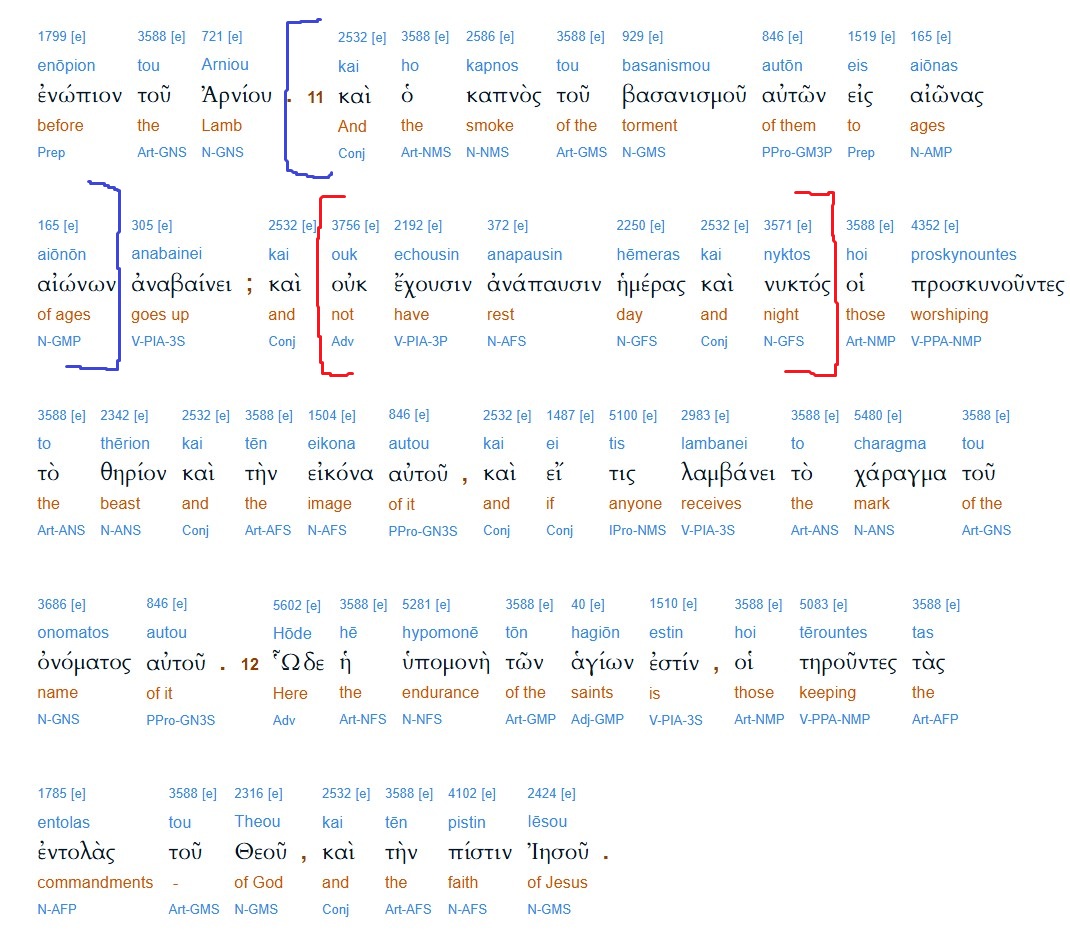
We can see how the usage of “smoke ascending” as the memory of their judgment being a common term. We can also see how their “torment goes up (*day and night).
Q What is the span of ( day, and night ) called?
Q How long exactly will their torment be?
If the span of this time is a literal 24 hour day, this means their torturous demise will be a limted event.
Have we seen this language before? Can it apply to something dead? Yes, this was sourced from the Old Testament.
Isaiah 66:24
“And they shall go forth and look
Upon the corpses of the men
Who have transgressed against Me.
For their worm does not die,
And their fire is not quenched.
They shall be an abhorrence to all flesh.”
All of these terms refer to what happens to the dead bodies. The Greek was not as clear as the Hebrew. However when we see where the Revelation 14:11 was sourced there is no doubt.
Are there any other verses that support the soul and body dying?
Daniel 7:11-12 (killing of the Beast)
“I watched then because of the sound of the pompous words which the horn was speaking; I watched till the beast was slain, and its body destroyed and given to the burning flame. As for the rest of the beasts, they had their dominion taken away, yet their lives were prolonged for a season and a time.
Luke 12:5 NKJV (killing of those at Judgement)
But I will show you whom you should fear: Fear Him who, after He has killed, has power to cast into hell (Gehenna); yes, I say to you, fear Him!
Matthew 10:28
And do not fear those who kill the body but cannot kill the soul. But rather fear Him who is able to destroy both soul and body in hell.
Paul states that the Corinthians ( the church ) has the Spirit in them, however if the church members defile the temple, they will be destroyed.
I Corinthians 3:16-17
Do you not know that you are the temple of God and that the Spirit of God dwells in you? If anyone defiles the temple of God, God will destroy him. For the temple of God is holy, which temple you are.
Revelation 19:19-20
19 And I saw the beast, the kings of the earth, and their armies, gathered together to make war against Him who sat on the horse and against His army. 20 Then the beast was captured, and with him the false prophet who worked signs in his presence, by which he deceived those who received the mark of the beast and those who worshiped his image. These two were cast alive into the lake of fire burning with brimstone.
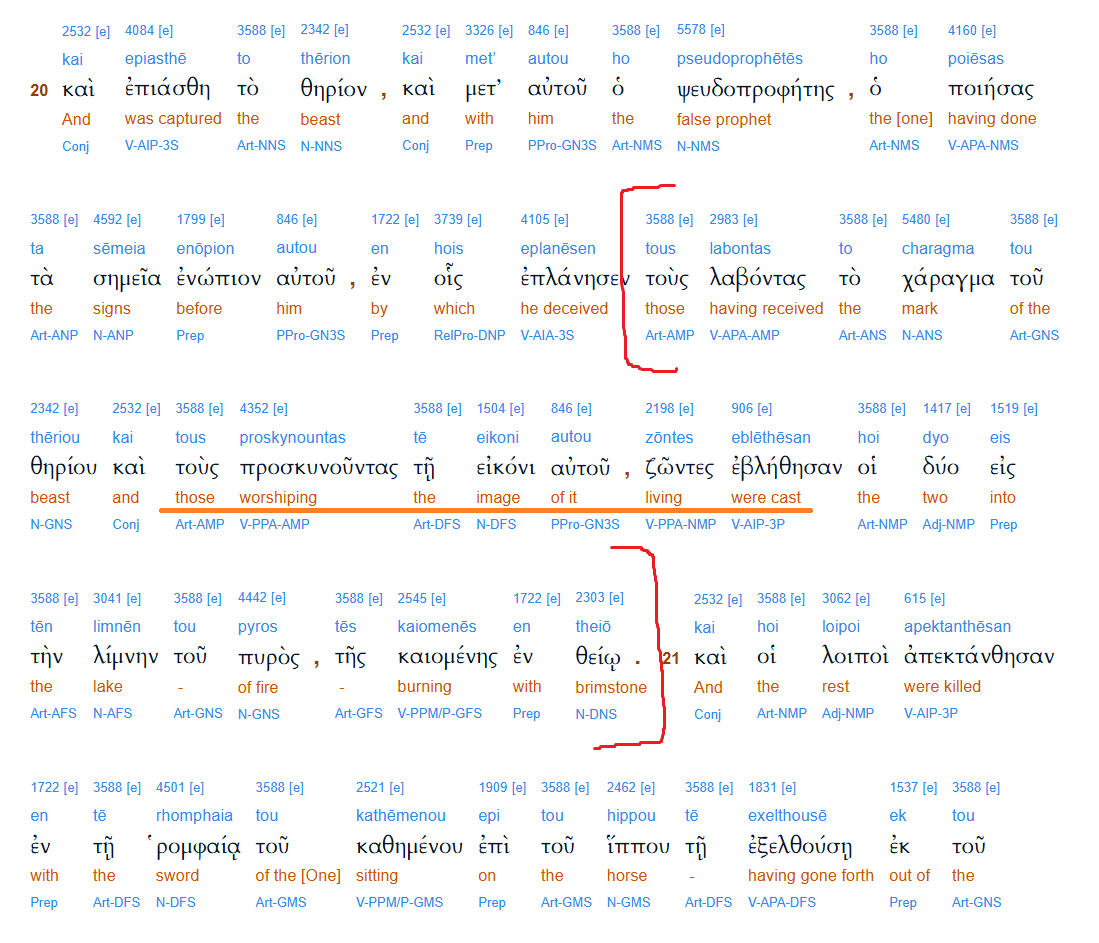
Q Why does the English say they were thrown “alive” into the lake of fire? Is this an accurate translation?
(Compare both the English to the Interlinear)
Q What exactly is the “image of it living”, if it is not people?
A Revelation 13
Revelation 13
14 And he deceives those who dwell on the earth by those signs which he was granted to do in the sight of the beast, telling those who dwell on the earth to make an image to the beast who was wounded by the sword and lived. 15 He was granted power to give breath to the image of the beast, that the image of the beast should both speak and cause as many as would not worship the image of the beast to be killed. 16 He causes all, both small and great, rich and poor, free and slave, to receive a mark on their right hand or on their foreheads, 17 and that no one may buy or sell except one who has the mark or the name of the beast, or the number of his name.
The answer of what image that was alive is answered in Rev 13:15. THIS is what is thrown into the lake of fire to burned. It is not thrown in “alive” as the image was only made to appear alive. Once you account for this object, there is no mention of any person or object being cast “alive” into any fiery torturous place.
Speaking of Lucifer the Cherub.
Ezekiel 28:18-19 NKJV
“You defiled your sanctuaries By the multitude of your iniquities, By the iniquity of your trading; Therefore I brought fire from your midst; It devoured you, And I turned you to ashes upon the earth In the sight of all who saw you. 19 All who knew you among the peoples are astonished at you; You have become a horror, And shall be no more.” ’ ”
Lucifer is turned to ashes on the earth. The fire is where? On the earth.
No more states their identity, or thinking is destroyed. No more means to not, and shall be. Literally speaks to unmaking, or UN-creating that which was made.
Conclusion
Allowing the Bible to define its meanings when originally written is very important.
We can see where “forever” was swapped in error for short periods of time in the Old and New Testaments. The translations of each into latter time languages did not account for the meanings of the words properly and arbitrarily assigned a vastly different meaning to our Bibles.
The West and Europe now have drawn conclusions and doctrine falsely regarding the length of time of events, and judgment in the Bible, which were VERY EASY with misunderstanding the Spirit and Soul. We do not have to go over all the doctrinal and theological differences individually to dispute them. The basics just need to be applied to the definitions of the words and their meanings in the order they appear in the Bible. It is now up to us to go out in love to our brothers and correct them using scripture.
Discuss
What are some misunderstandings we hold as a result of these miss-interpretations? Is it ok to question what we are taught in church? When is it appropriate and what is the best way to address this?
References: https://tentmaker.org/articles/EternityExplained.html